Generator Brief
How to Name the People of a Place
Use this demonym generator when the place name is already set and your next problem is social identity. It turns cities, kingdoms, islands, and empires into believable inhabitant forms that can survive map labels, army names, encyclopedia entries, and in-world dialogue.
Resident-Form Sound
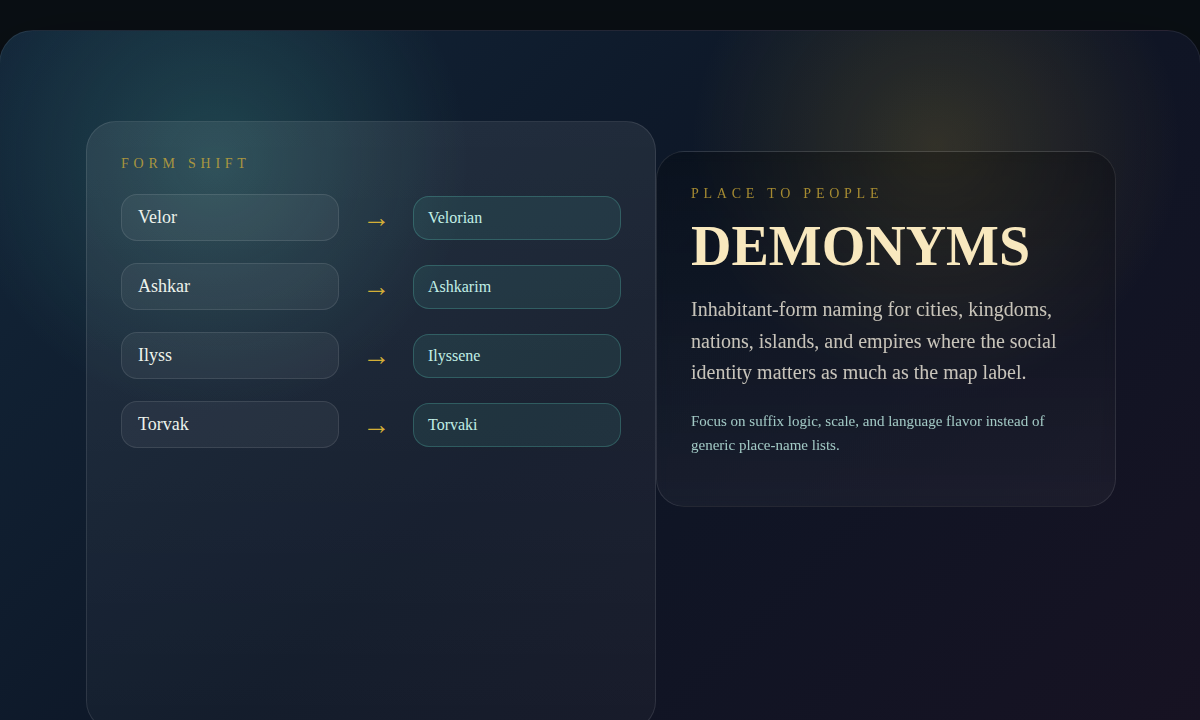
Strong demonyms echo the root place name without looking mechanically stitched on. Short settlements usually want tighter endings, while older states and ceremonial powers often read better with longer inhabitant forms that sound civic, imperial, or historical.
Turn Geography into Identity
A demonym, sometimes called a gentilic, is the name for the people of a place. In fiction that means converting a map label into something socially usable: the word traders are called, the adjective historians use, or the banner soldiers carry. Good demonyms feel tied to the source place while still sounding like a real group identity.
When This Tool Is the Right Move
Demonym is strongest when the geography already exists and the missing piece is what the residents are called. It works especially well for fantasy atlases, campaign settings, alt-history projects, strategy-game factions, and lore docs where cities, nations, migrants, or rival peoples need names that feel grounded in the same world.
- ▸ Create inhabitant terms for fantasy capitals, ports, and frontier cities
- ▸ Generate kingdom, empire, republic, and regional gentilics
- ▸ Fill out lore bibles, faction rosters, map legends, and political summaries
- ▸ Keep neighboring regions consistent by reusing suffix logic across a whole map
How to Get Better Results
Start with place scale, because city demonyms usually land differently from national or imperial forms. Then pick a language flavor that matches your setting. If you already have canon geography, add the exact place name so the output can keep the right root sounds instead of drifting toward a generic fantasy ending.
Common Demonym Mistakes
The easiest way to break immersion is to attach a random suffix with no regard for scale or pronunciation. A city demonym should not sound as imperial as a continent-wide power, and a resident adjective should still read naturally in prose. If the form feels tongue-twisting in dialogue, shorten the ending and keep more of the root place name.