Character prompt
Sylvaris Dawnsong
Create unique and mystical elven names for your fantasy characters
Live output
Generator Brief
Elven names favor flowing vowels, soft consonants, and melodic multi-syllable rhythm, but each subtype bends those rules differently. Use culture options to move from regal High Elf elegance to airy Wood Elf naturalism or sharper dusk-born and shadowed variants.
Structure Guide
Lean on open vowels and soft consonants to keep names airy and ancient.
High, Wood, and Dark variants should share roots but differ in edge and cadence.
Limit heavy consonant stacks unless aiming for a militaristic Dark Elf tone.
Use 3–4 syllables for nobles and mages; 2 syllables for scouts or commoners.
Lock a cultural preset before generating NPC batches for one city or forest realm.
Combine a short epithet to signal lineage, duty, or realm allegiance.
Lineage Logic
Elf names work best when the sound system matches the social world around the character. Noble houses, woodland scouts, and twilight courts should all feel related, but not interchangeable.
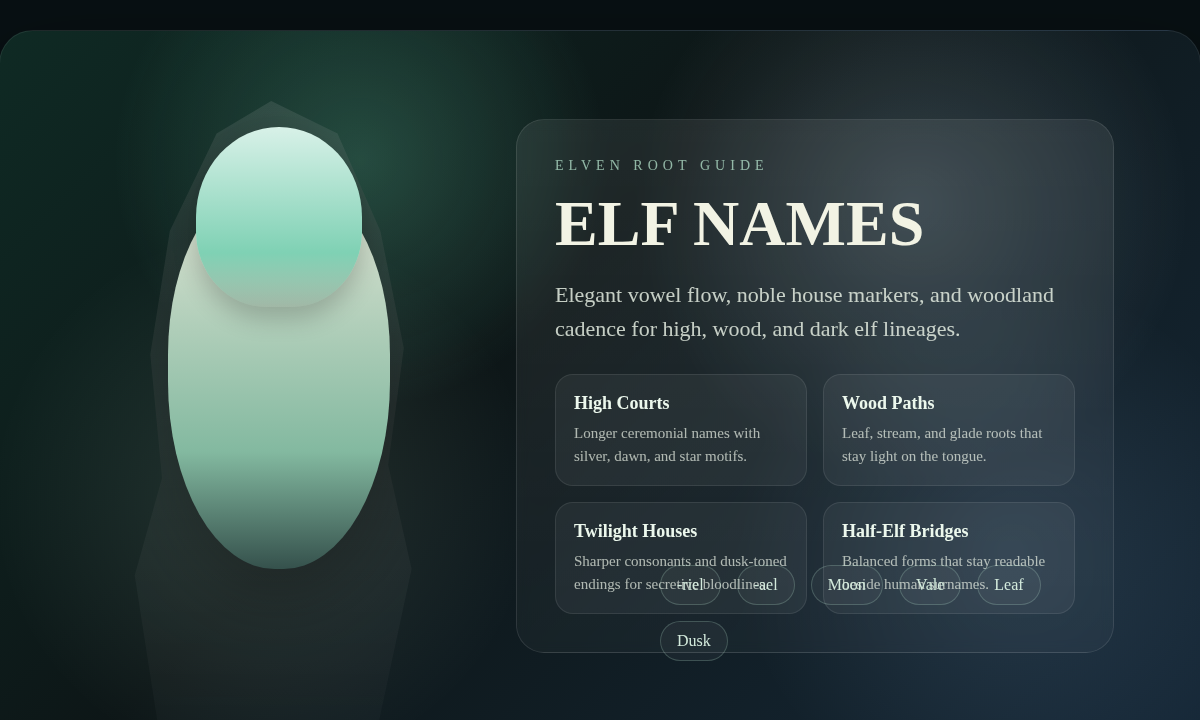
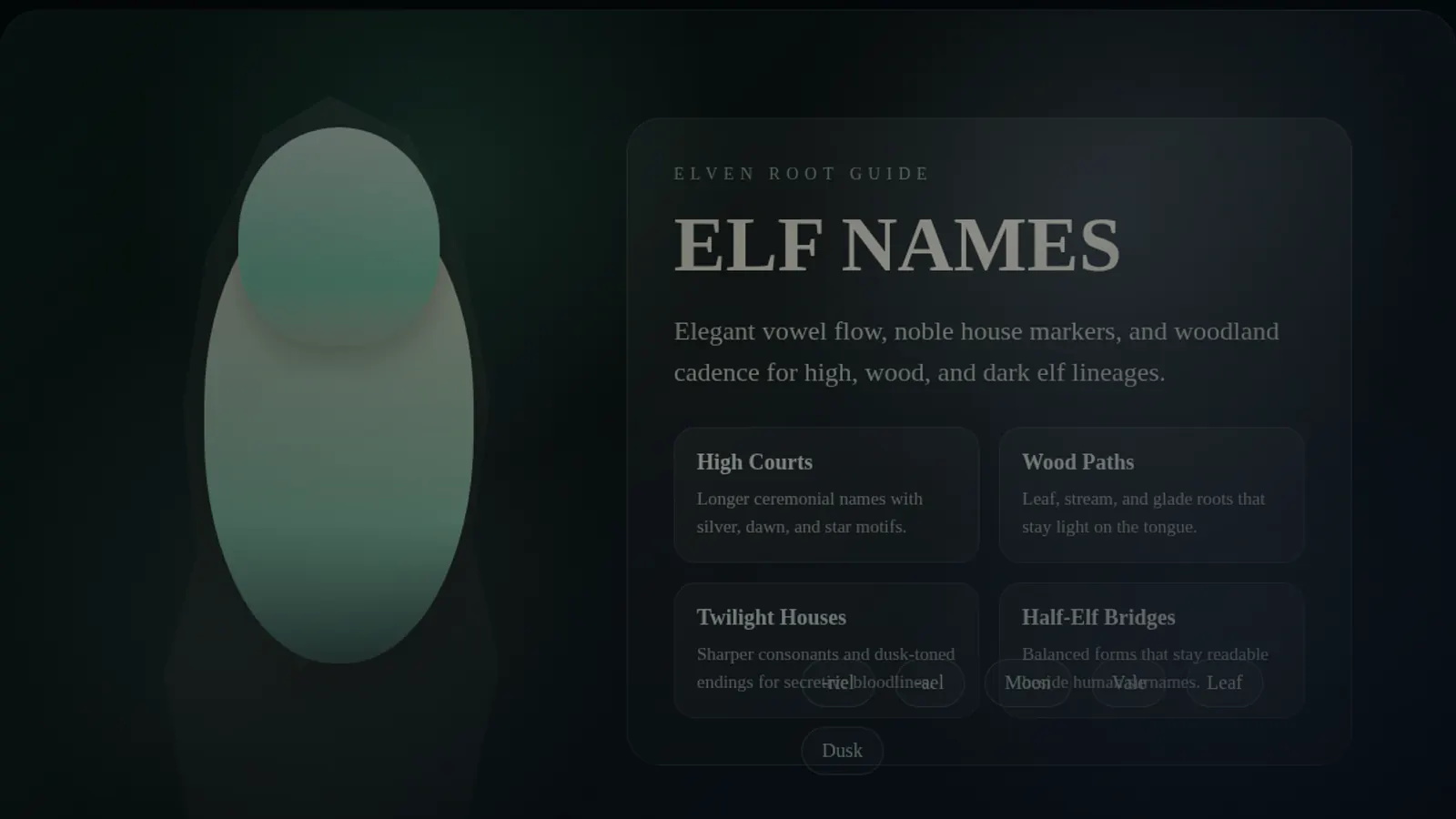
Elven Root Guide
Elven naming reference board showing noble, woodland, and twilight naming directions for fantasy characters.
A page-specific visual for noble, woodland, and dusk-born name families.
Chooser
Elf Names is for race-specific cadence, lineage, and cultural subtype. It works best when your naming problem is a person or house inside an elven society, not a broad world surface or a place-derived people label.
Lineage Advantages
Blends linguistic authenticity with flexible culture presets for fantasy writers, D&D players, and worldbuilders building memorable elven characters.
Names follow authentic Elvish phonetic patterns inspired by Tolkien's Sindarin and Quenya, ensuring they sound natural and fitting for any fantasy setting.
Generate names for High Elves, Wood Elves, and Dark Elves, each with distinct naming conventions that reflect their unique cultural heritage and values.
Ideal for creating memorable D&D characters, NPCs, and entire elven civilizations. Compatible with all fantasy RPG systems and campaigns.
Each name comes with meaning and cultural context, helping authors create rich backstories and maintain consistency in their fantasy worlds.
Generate up to 20 unique elf names at once. No signup required, completely free, and works instantly in your browser.
Create an account to save your favorite names, build character collections, and access your naming history across all devices.
Lineage Samples
Discover the beauty and depth of elven names. Each name carries a story, reflecting the rich cultural heritage and mystical nature of elven society. Below are carefully curated examples showcasing different styles, origins, and meanings:
Meaning: Crowned maiden of radiant light
Origin: High Elf
A noble name befitting a powerful sorceress or wise leader. The suffix "-driel" indicates nobility and grace.
FemaleMeaning: Vigorous spring beneath moonlight
Origin: Wood Elf
Perfect for a ranger or woodland guardian. Combines natural elements with mystical qualities.
MaleMeaning: Silver tree under starlight
Origin: High Elf
A regal name suggesting ancient wisdom and celestial connection, ideal for elven lords.
MaleMeaning: Noble maiden of the evening star
Origin: High Elf
A timeless name combining elegance with celestial beauty, perfect for diplomatic characters.
FemaleMeaning: Green leaves of the forest
Origin: Wood Elf
Ideal for agile archers and forest dwellers. Simple yet evocative of natural grace.
MaleMeaning: Enchantress, daughter of twilight
Origin: High Elf
A legendary name for characters with magical abilities and ethereal beauty.
Female| Culture | Sound Pattern | Common Themes | Example Names | Best For |
|---|---|---|---|---|
| High Elf | Elegant, flowing, multi-syllabic with soft consonants | Stars, light, nobility, wisdom, silver | Galadriel, Elrond, Celeborn, Arwen | Wizards, nobles, diplomats, scholars |
| Wood Elf | Nature-inspired, rhythmic, shorter syllables | Trees, leaves, forests, rivers, animals | Legolas, Tauriel, Nimrodel, Haldir | Rangers, druids, hunters, guardians |
| Dark Elf | Sharp consonants, mysterious, exotic sounds | Shadows, night, power, magic, darkness | Drizzt, Malekith, Morathi, Gwindor | Rogues, warlocks, anti-heroes, exiles |
| Half-Elf | Blended styles, adaptable, shorter than full elves | Mixed heritage, duality, versatility | Elrond Peredhel, Elros, Dior | Diplomats, adventurers, bridge characters |
Cadence Checks
A wise, ancient elf might have a longer, more complex name (like Círdan Shipwright), while a young, energetic character could have a simpler name (like Tauriel).
Warriors often have strong-sounding names (Glorfindel), while mages prefer celestial references (Elenwë Starshine).
Common endings: -iel (maiden), -orn (tree), -las (leaf), -wen (maiden), -ion (son of), -dir (man/lord).
Choose names that are easy to say aloud. Test them in your gaming sessions or read them in your story.
Keep names consistent with your character's background. Don't mix High Elf and Dark Elf naming conventions.
Elven surnames often reference nature (Silverleaf, Moonwhisper) or family heritage (Starweaver, Lightbringer). Choose surnames that complement the first name.
House Questions
They are not direct lifts from canon Elvish languages, but they are shaped by elven-style phonetics and fantasy naming patterns so they feel readable, melodic, and culturally believable inside a fantasy setting.
Absolutely. These names are built for D&D, Pathfinder, fantasy fiction, campaign prep, and game development. They are free to use for personal and commercial creative work, with the usual caution around existing branded characters or titles.
Gender settings mostly shift cadence and ending tendencies rather than enforcing strict rules. Softer endings may read more lyrical, firmer endings can feel more formal or martial, and neutral settings help when you want broader elven naming without locking into one presentation.
Start with culture and social role. High Elf names suit nobles, diplomats, scholars, and court mages; Wood Elf names fit scouts, druids, and rangers; darker variants fit exiles, shadow courts, and morally complex characters. Then match length and type to rank and lineage.
Yes. Mix and match given names with house names, trim syllables, or use a generated result as a lineage template for related NPCs. Elven naming often gets stronger when several family members clearly share one sound system.
Use Elf Names when race-specific cadence, lineage tone, and cultural subtype matter more than broad versatility. Fantasy Names is better when you still need to switch between characters, cities, guilds, and artifacts in one workspace.
Making every elf sound equally ornate. Nobles, wardens, wanderers, and half-elves should not all carry the same syllable weight. Let house status, woodland closeness, and social role change the cadence.
Use Elf Names or elven names when lineage, house style, and race-specific cadence matter. Use Fantasy Names when the project is still broader than elves and may include cities, guilds, kingdoms, or artifacts too.
Neighboring Lanes
Browse all character name tools
Generate kingdoms, cities, and locations
Create names for weapons and artifacts
Compare when to use elven lineage rules versus the broader fantasy name generator
Outside References